KCJ Knowledge Center
Bridging Tradition, Quality, and Global Commerce.
What Is Kosher Certification?
Definition & Purpose
Kosher certification confirms that food complies with kashrut, the dietary laws derived from the Torah and rabbinic texts. It ensures that permissible animals are properly slaughtered, dairy and meat are separated, and the ingredients and production processes meet stringent guidelines (The Business Research Company, American Halal Foundation).Benefits Beyond Religious Observance
Certification also signals food safety, quality assurance, and traceability—valuable even for secular consumers and global markets (Badatz Kosher Certification Worldwide, Iasiso Gulf).
Why Kosher Certification Matters in Arab Countries
Tourism, Hospitality & Global Business Appeal
In the UAE, a Kosher certification project by the Department of Culture and Tourism nudged hotels to offer kosher options (Plnt Food, KLBD Kosher). Emirates Flight Catering launched Kosher Arabia in 2021, building a state-of-the-art kosher facility to serve global clientele (Plnt Food).Perception of Quality & Safety
In Saudi Arabia, Kosher certification is increasingly associated with food safety, responsibility, and consumer confidence, prompting even non-Jewish consumers to favor certified products (Iasiso Gulf).Existing Trade Dynamics
Some Arab food producers continue to export to Israel, with their products certified kosher and sold there under ongoing trade links (Middle East Eye).
Economic Insights: Kosher Products in the US, Canada & EU
Global Market Snapshot
Market Size & Growth
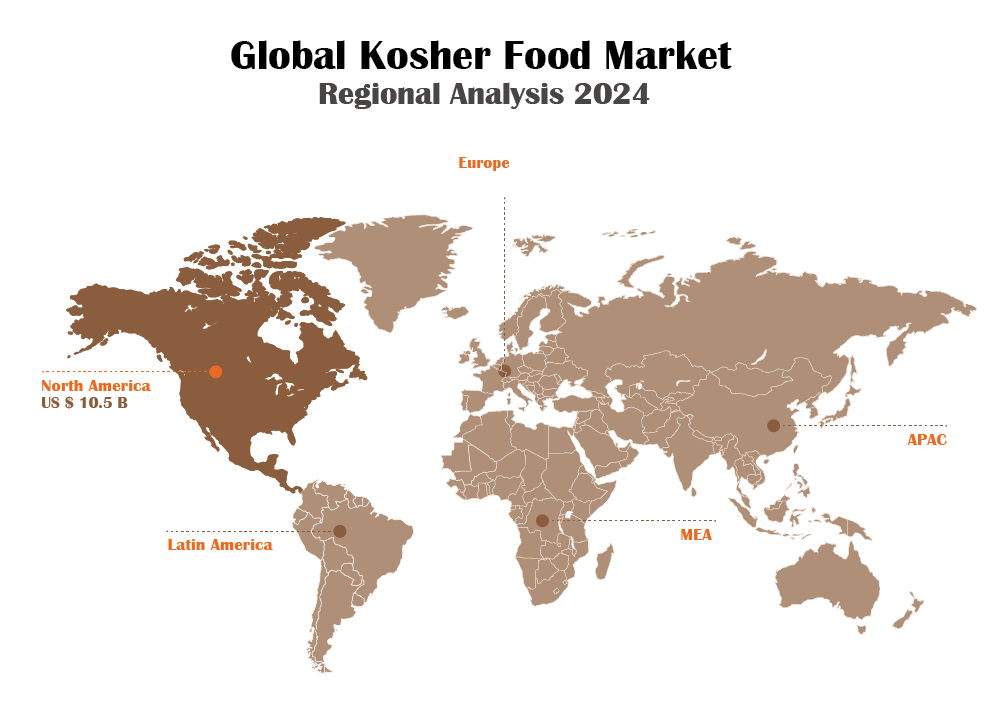
In 2024, the kosher food market was estimated at USD 21.13 billion, projected to grow to USD 21.93 billion in 2025, and reach USD 25.46 billion by 2029 with a ~3.8% CAGR (The Business Research Company).
Another source projects a valuation of USD 24.8 billion in 2024, with a rise to USD 39.2 billion by 2033 (CAGR ~5.3%) (DataHorizzon Research).
A more aggressive outlook pegs the market at USD 79.1 billion by 2034 (CAGR 9.3%)—with North America comprising ~38% and Europe ~27% of market share (Global Growth Insights).
Key Drivers
Growing demand from health-conscious, non-Jewish consumers who view kosher as safer or higher quality (44% prefer certified foods; 36% associate with hygiene) (Global Growth Insights).
Expansion of kosher plant-based, vegan, and gluten-free products—accounting for ~31% growth in new specialty offerings (Global Growth Insights).
Retailers allocating more shelf space: e.g., 28% increase for kosher items, and 34% growth in private-label kosher lines (Global Growth Insights).
US, Canada, and EU Highlights
United States
The U.S. is a powerhouse in the kosher market, contributing significantly to global demand.Canada
A Reuters report from April 2025 highlighted a shortage of Manischewitz kosher wine due to U.S.–Canada trade tensions, spotlighting market vulnerabilities tied to geopolitical events (Reuters). This has opened avenues for local producers like Elman’s Food Products to expand their domestic offerings, especially during Passover (Reuters).European Union
While exact figures were not available in the sources, Europe represents a sizable ~27% of the kosher food market (Global Growth Insights). (Note: region-specific challenges exist, including differing regulations on ritual slaughter.)
Kosher Products in Major Retailers: Costco & Walmart
Costco & Passover
Canada’s COR (Kashruth Council of Canada) publishes yearly “Costco for Passover” lists—a sign that retailers like Costco carry significant kosher product ranges seasonally (Plnt Food, Research and Markets).Walmart
Direct data on Walmart’s national kosher food offerings wasn’t found in our recent search. However, seasonal expansions and growing specialty food segments imply that large chains like Walmart are increasingly stocking kosher-certified products.
Conclusion
Kosher certification is emerging as a powerful tool for quality, trust, and market access—not just within Jewish jurisdictions, but across diverse global sectors. Its relevance in Arab hospitality, fast-growth Western markets, and large retailers like Costco underscores its economic and cultural importance in 2025 and beyond.
SHARE:
KCJ Blog & Articles
latest posts
The Future of Kosher Certification
Key Trends in Kosher Certification 2025
Why Become Kosher
Food Transparency: A Growing Consumer Expectation
Ancient Laws and Modern Market
KCJ TRADEMARK
KCJ view certification as a partnership, not transaction.
Over the decades, we have nurtured long-lasting relationships with our clients, built on mutual respect, collaboration, and a shared vision for success.
KCJ‘s approach combines exceptional customer service, a transparent and reasonable fee structure, and an unwavering commitment to guiding our clients through every stage of certification.